

TL;DR:
- Dressing professionally for a LinkedIn headshot involves selecting industry-appropriate, well-fitted attire that communicates confidence and credibility. Wearing solid, mid-tone colors and avoiding patterns or excessive accessories helps keep the focus on your face and enhances your personal brand. Proper preparation, including outfit testing and grooming, is essential to produce a polished, authentic image that attracts opportunities.
Dressing professionally for a LinkedIn headshot means selecting attire that communicates your qualifications, aligns with your industry, and projects confidence before you say a single word. LinkedIn profiles with photos receive up to 21 times more views and 9 times more connection requests than those without. That number tells you one thing: your photo is doing real work before any recruiter reads your headline. The clothes you wear in that photo are not decoration. They are professional communication, and getting them right is one of the most direct ways to strengthen your personal brand and improve your job prospects.
How to dress professionally for a LinkedIn headshot across industries
Professional attire for a LinkedIn headshot is not a single uniform. It is a spectrum, and where you land on that spectrum depends entirely on your field. The standard rule is to dress one level above your typical daily work attire and align with your industry’s dress code. This signals that you take your professional image seriously without looking out of place in your own sector.
Here is how that breaks down by industry:
- Finance, law, and consulting: A tailored blazer, button-down shirt, or structured blouse communicates authority. Men should consider a suit jacket or sport coat. Women do well with a blazer over a solid blouse or a structured dress. Ties are optional but should be simple and solid if worn.
- Tech and startups: Business casual is the standard. A clean, well-fitted collared shirt or a smart crew-neck sweater reads as polished without feeling stiff. Avoid hoodies or graphic tees, even if that is what you wear to the office every day.
- Healthcare and education: A clean, pressed shirt or blouse in a neutral or mid-tone color works well. Some healthcare professionals choose to include a white coat, which is acceptable as long as it is spotless and pressed.
- Creative fields (design, marketing, media): You have more room to show personality through color and style, but the photo still needs to look intentional. A bold solid color or a well-fitted modern silhouette works better than anything that reads as casual or unfinished.
Your clothes should add to your professional image and not distract from your qualifications or skills. That principle applies across every industry. If someone looks at your photo and notices your outfit before they notice your face, the outfit is doing the wrong job.
Pro Tip: If you are unsure about your industry’s formality level, look at the LinkedIn profiles of people two or three levels above you in your field. Their attire is your target.
What colors and patterns work best for headshots?
Color is one of the most powerful and most overlooked variables in headshot attire. Solid colors like navy, charcoal, and burgundy photograph well under studio lighting. Mid-tones draw the viewer’s eye to your face rather than your clothing, which is exactly where attention belongs.
| Color or Pattern | Effect in Photos | Recommendation |
|---|---|---|
| Navy, charcoal, forest green | Flattering mid-tones, face-forward | Strongly recommended |
| Burgundy, rust, earth tones | Warm and approachable on most skin tones | Recommended |
| Pure white | Can blow out under studio lighting, loses detail | Use with caution |
| Pure black | Can flatten and lose texture in photos | Use with caution |
| Bold patterns, pinstripes, florals | Compete with facial expressions, can cause moiré effects | Avoid |
Pure black and white are not automatically wrong, but they require careful lighting to avoid looking flat or washed out. A photographer who knows what they are doing can work with both, but mid-tones give you a wider margin for a great result. Earth tones like camel, olive, and warm gray tend to photograph beautifully and feel current without being trendy.
Logos, bold graphics, and statement prints pull focus away from your face. The same applies to flashy or excessive jewelry. A simple watch, stud earrings, or a delicate necklace adds polish. A chunky statement necklace or a novelty tie becomes the first thing people see.
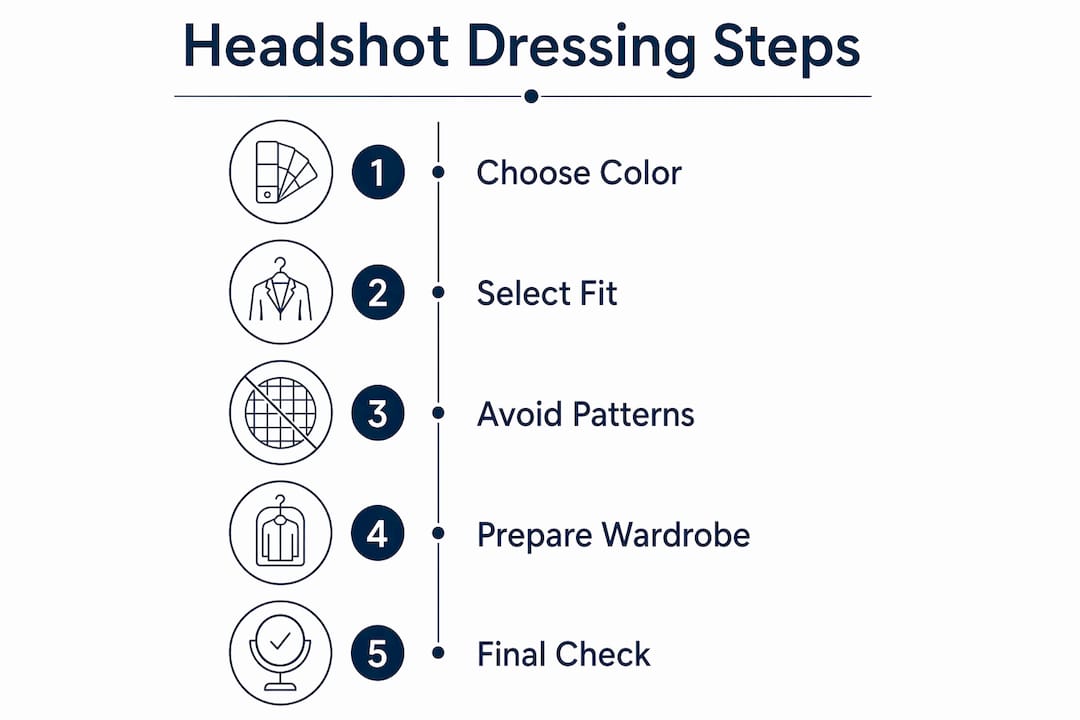
Pro Tip: Hold your outfit up against your face in natural light before the session. If the color makes your skin look dull or washed out, swap it. The right color makes your eyes pop and your complexion look healthy.
How to prepare your wardrobe before the session
Preparation is where most people lose points before the camera ever fires. The clothes you choose matter, but how you bring them to the session matters just as much.
- Bring two to three outfit options. Multiple outfits give you flexibility on the day and protect you if one option does not work under the lights. A backup blazer in a different color takes up almost no space and can completely change the tone of your gallery.
- Iron or steam everything the night before. Wrinkles photograph sharply and are distracting in ways that are hard to fix in post-production. Hang your outfits after steaming so they do not re-wrinkle in transit. Transport them on hangers, not folded in a bag.
- Avoid wearing new clothes for the first time. New clothes can surprise you with fit issues, uncomfortable seams, or stiffness that reads as awkward on camera. Wear each outfit at least once before the session so you know how it moves and feels.
- Time your haircut correctly. A haircut 7 to 10 days before the shoot gives your hair time to settle into its natural shape. A same-day cut often looks too fresh and can feel stiff or unfamiliar.
- Plan your makeup for camera, not daily life. Camera-ready makeup is slightly more defined than your everyday look but not as heavy as evening wear. Matte finishes reduce shine under studio lights. If you wear glasses, clean the lenses the morning of the shoot and consider an anti-reflective coating if you have not already.
Pro Tip: Pack a small kit for the session: a lint roller, a travel steamer or wrinkle-release spray, safety pins, and a neutral lip color for touch-ups. These take five minutes to assemble and can save a shot.
Common wardrobe mistakes that undermine your headshot
Knowing what to avoid is just as useful as knowing what to wear. These are the most common attire errors that show up in LinkedIn headshots, and they are all preventable.
- Dressing too casually for your industry. A t-shirt might be your daily uniform, but it signals a lack of effort in a professional photo context. Even in relaxed industries, a clean collared shirt or structured top reads as intentional.
- Wearing busy or trendy patterns. Pinstripes, bold checks, and florals compete with your face and can create a moiré effect on screen. Solid colors are the safer and more timeless choice.
- Ill-fitting clothes. A jacket that pulls at the shoulders or a shirt that gaps at the buttons draws the eye immediately. Fit matters more than brand or price. A well-fitted shirt from any retailer beats an expensive suit that does not sit right.
- Excessive accessories. Statement jewelry, novelty ties, and oversized watches shift attention away from your expression. Keep accessories minimal and classic.
- Wearing pure white or pure black without testing. Both extremes can create exposure problems under studio lighting. If you love white, opt for off-white or cream. If you prefer dark tones, charcoal or deep navy give you the same effect with better photographic results.
- Choosing clothes you have never worn before. Unfamiliar clothes affect how you carry yourself. If you are adjusting a collar or tugging at a sleeve every few minutes, it shows in the photos.
Visual style in photos influences perceived character, trustworthiness, and competency before any verbal interaction takes place. Every one of these mistakes chips away at that first impression.
Key takeaways
Dressing professionally for a LinkedIn headshot requires choosing industry-appropriate attire, flattering mid-tone colors, and well-fitted clothing that keeps the viewer’s focus on your face.
| Point | Details |
|---|---|
| Dress one level above daily attire | Match your industry’s formality and signal that you take your professional image seriously. |
| Choose mid-tone solid colors | Navy, charcoal, burgundy, and earth tones photograph well and keep focus on your face. |
| Prepare and test outfits in advance | Bring two to three ironed options and wear each piece at least once before the session. |
| Avoid patterns, logos, and excess accessories | Busy visuals compete with your expression and undermine the professional impression. |
| Grooming and fit are part of the outfit | A well-timed haircut and properly fitted clothing complete the professional look on camera. |
What wardrobe actually communicates in a headshot
I have worked with hundreds of professionals across South Florida, and the wardrobe conversation is almost always the one people underestimate the most. They spend weeks thinking about the right photographer and the right backdrop, then show up in a shirt they grabbed that morning.
Here is what I have observed consistently: the clients who arrive with two or three prepared options, ironed and tested, almost always leave with a stronger gallery. Not because the extra outfit is always used, but because the preparation reflects a mindset. They have thought about how they want to be perceived, and that intention shows in how they carry themselves in front of the camera.
The deeper point is this: wardrobe as professional communication is not about looking like someone else. It is about looking like the most credible, confident version of yourself. The best headshot attire does not announce itself. It simply gets out of the way and lets your face do the work. When a client’s photo makes someone stop scrolling on LinkedIn, it is rarely because of the blazer. But the blazer is part of why the photo felt trustworthy enough to stop for.
Authenticity and professionalism are not opposites. You can wear something that feels like you and still looks polished. That balance is exactly what we help clients find at Eric Campbell Photography before the session even starts.
— Mike
Get expert guidance on your headshot attire
At Eric Campbell Photography, wardrobe preparation is built into the session experience. Before you arrive at the Fort Lauderdale studio, you get a pre-session consultation that covers your goals, your industry, and the platforms where your images will live. A personalized color chart helps you identify which tones work best for your complexion, so you are not guessing in front of the mirror the night before. If you want to understand the full value of a professional headshot for your career, that resource breaks down exactly what you are investing in and why it pays off. You can also explore what to wear for headshots for a deeper look at style and color guidance before you book. Call 954.766.1954 or visit ericcampbellphotography.com to plan your session.
FAQ
What should I wear for a LinkedIn headshot?
Wear solid, mid-tone colors like navy, charcoal, or burgundy in clothing that fits well and aligns with your industry’s formality level. Dress one level above your typical daily attire to signal professionalism.
Should I avoid black and white clothing for headshots?
Pure black and pure white can create exposure problems under studio lighting, losing texture or appearing blown out. Opt for off-white, cream, charcoal, or deep navy as safer alternatives.
How many outfits should I bring to a headshot session?
Bringing two to three outfit options is the standard recommendation, giving you flexibility and a backup if one choice does not work under the lights.
Do patterns work for LinkedIn headshot attire?
Patterns like pinstripes, bold checks, and florals compete with your facial expression and can cause a moiré effect on screen. Solid colors are the more reliable and timeless choice for professional photos.
Does grooming count as part of headshot preparation?
Yes. A haircut timed 7 to 10 days before the session, clean glasses, and camera-ready makeup all contribute to the overall professional impression your headshot creates.