

TL;DR:
- Medical branding photography is a strategic visual tool that shapes patient perception before appointments, emphasizing authenticity and emotional connection. It requires separate workflows from clinical photography to maintain credibility, privacy, and aesthetic consistency across platforms. Regular updates and intentional planning enhance trust and distinguish practices in a competitive healthcare landscape.
Most physicians and healthcare marketers treat all medical photography the same way. They grab a smartphone, snap a few photos of the team, post them to the website, and call it done. That approach misses the entire point of medical branding photography explained properly: it is a strategic discipline, completely separate from clinical documentation, designed to shape how patients perceive your practice before they ever book an appointment. Get it right, and your imagery builds trust at the first glance. Get it wrong, and even the most skilled clinician can look untrustworthy online.
Table of Contents
- Key takeaways
- Medical branding photography explained: definitions and purpose
- How imagery shapes patient trust
- Clinical vs. branding photography: key differences
- Practical steps for implementing branding photography
- My perspective on healthcare photography’s real value
- Get branding photography that works for your practice
- FAQ
Key takeaways
| Point | Details |
|---|---|
| Branding vs. clinical photography | Medical branding photography serves emotional and marketing goals, not clinical documentation standards. |
| Authenticity drives trust | Real provider photos increase patient trust two to three times more than stock imagery. |
| Visual consistency matters | Consistent imagery across touchpoints can increase patient trust by up to 30%. |
| Keep workflows separate | Mixing clinical and branding photography creates credibility and privacy risks for your practice. |
| Treat branding as ongoing | Regular photography updates are part of a long-term brand investment, not a one-time task. |
Medical branding photography explained: definitions and purpose
Medical branding photography is the intentional creation of visual content designed to communicate a healthcare provider’s identity, values, and patient experience. It is not about documenting a procedure or capturing a clinical outcome. The goal is to make a prospective patient feel something: confidence, comfort, safety, and connection.
The types of images that fall under this category include:
- Provider portraits: Professional headshots and environmental portraits that showcase the clinician as approachable and credible
- Team photos: Group imagery showing the staff as a cohesive, welcoming unit
- Practice environment shots: Photos of waiting rooms, treatment areas, and facilities that communicate cleanliness, warmth, and professionalism
- Patient experience imagery: Carefully staged scenes that show the care journey without real patient identities, conveying empathy and attentiveness
Visual style matters enormously here. Color palettes, lighting choices, and composition all send signals. Warm, natural light reads as approachable. Stark, overly clinical lighting can feel cold. Visual storytelling in healthcare works through deliberate use of color psychology and emotional cues tailored to the specialty and its patient demographics. A pediatric practice should look entirely different from a surgical center, even though both need professional imagery.
If you’re ready to get your own provider portraits handled, take a look at our doctor headshot photography to see examples and book a session.
Pro Tip: Before any branding shoot, write down three words you want patients to feel when they see your images. Share those words with your photographer so every lighting choice and composition decision supports that emotional goal.
How imagery shapes patient trust
Patients make decisions about healthcare providers faster than most practitioners realize. A website visit that lasts under a minute can determine whether someone books or bounces. The visual content on that page is doing most of the persuading.
88% of patients value authenticity and honesty in healthcare visual branding as the most critical factors for trust. That is not a small preference. It is a near-universal expectation. And yet, many practices still rely on generic stock images of smiling models in lab coats, none of whom work at the clinic.
The data on this is striking. Patients are two to three times more likely to trust a practice when they see real photos of the actual clinicians who will be treating them. The logic is intuitive. A patient choosing a doctor is making a personal, sometimes vulnerable decision. Seeing the real face behind the practice removes uncertainty and creates a human connection before the first appointment.
“Trust in healthcare is a baseline expectation. Branding photography must go beyond to create differentiated, specialty-specific credibility that separates one practice from the next.”
Visual consistency also compounds the effect. Consistent visual elements across your website, social media profiles, email newsletters, and physical signage can increase patient trust metrics by up to 30%. This means using the same color palette, same photographic style, same lighting tone across every platform where patients encounter your brand. When the imagery feels cohesive, the practice feels trustworthy. Inconsistency, even subtle inconsistency, creates subconscious doubt.
Clinical vs. branding photography: key differences
This is where many practices create real problems for themselves. Clinical photography and branding photography are not interchangeable, and treating them that way carries meaningful risk.
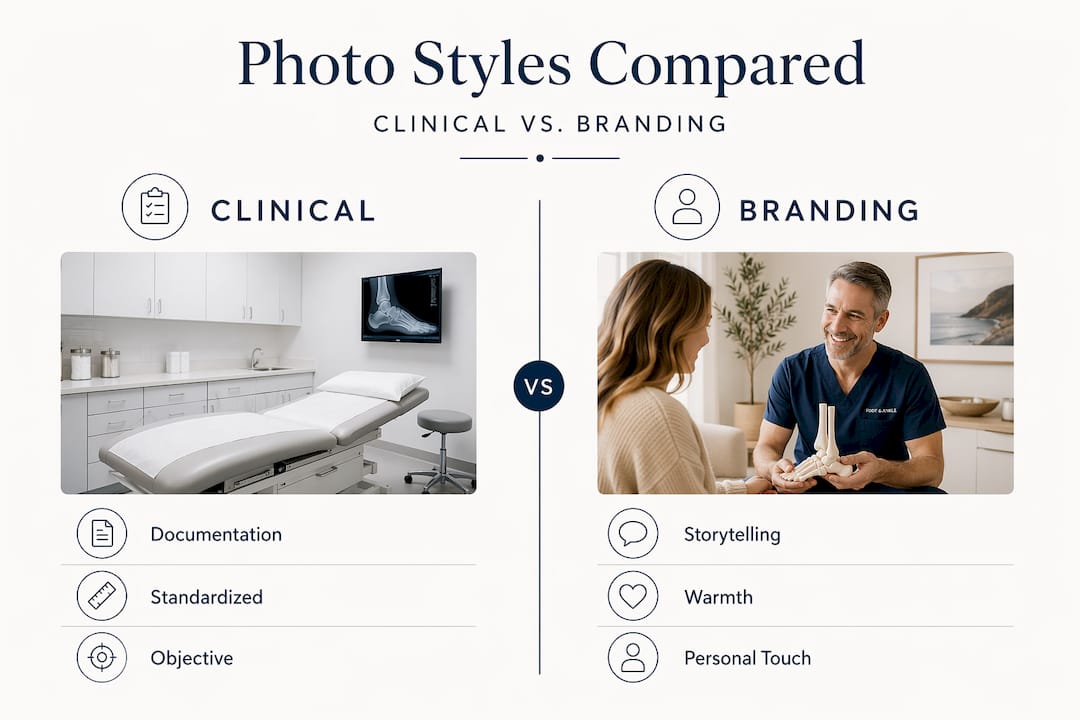
| Factor | Clinical photography | Branding photography |
|---|---|---|
| Primary goal | Accurate documentation for diagnosis or records | Emotional connection and brand perception |
| Technical requirements | Color calibration, fixed lighting, standardized angles | Mood-driven lighting, natural composition, warmth |
| Subject | Conditions, wounds, procedures, outcomes | Providers, staff, environment, patient experience |
| Privacy considerations | Strict consent and data protection standards | Staged or non-identifying imagery only |
| Equipment standard | Controlled conditions, calibrated devices | Professional cameras with branding-appropriate setups |
Up to 93% of routine clinical photographs are taken on personal smartphones, which creates obvious quality inconsistencies. That statistic reveals two things: clinical workflows are often informal, and the gap between what passes for clinical documentation and what qualifies as professional branding imagery is enormous.
Clinical photography requires rigorous standardization, including consistent color rendering, fixed focal lengths, and strict patient consent protocols. Branding photography prioritizes aesthetics, emotional resonance, and narrative. Conflating the two risks loss of patient trust, potential privacy breaches, and real damage to your practice’s professional standing.
Pro Tip: Keep your clinical photography workflow and your branding photography workflow completely separate, with different equipment, different storage, and different consent processes. They serve different purposes and should never overlap.
Practical steps for implementing branding photography
Getting your medical branding photography right is not complicated, but it does require intentional planning. Here is a process that works for medical practices of any size.
- Define your brand goals first. Before you hire a photographer or pick a location, clarify what you want these images to communicate. Are you projecting clinical authority? Warmth and accessibility? Specialty expertise? Your goals shape every subsequent decision.
- Choose subjects strategically. Lead physicians and patient-facing staff should always be included. Front-desk teams and care coordinators often get overlooked, but they are frequently the first real human contact a patient has with your practice. Include them.
- Select locations with intention. Your clinic entrance, consultation rooms, and any spaces patients actually experience are the right backdrops. Avoid generic blank walls unless that look specifically fits your brand. Context communicates more than most practitioners realize.
- Work with a professional photographer who understands branding. The technical skill of a professional makes a measurable difference. Someone with experience in photography for healthcare professionals understands how to direct non-models, create genuine expression, and produce imagery that looks both polished and authentic.
- Update your imagery regularly. Branding is a living system that requires ongoing investment. Major hospital systems have spent tens of millions on rebranding efforts that include photography refreshes precisely because outdated imagery erodes credibility. For individual practices, an annual or biannual update is a reasonable standard.
- Audit your current visual presence before the shoot. Review your website, Google Business Profile, social channels, and any printed materials. Identify where imagery is outdated, inconsistent, or stock-based. That audit tells you exactly what the shoot needs to address.
Pro Tip: Brief your photographer on your patient demographics before the session. Healthcare branding that aligns to patient emotional needs outperforms trend-based photography every time. A concierge dermatology practice in an affluent market needs different visual cues than a community pediatric clinic.
My perspective on healthcare photography’s real value
I have worked with medical professionals across South Florida for more than a decade, and I want to say something plainly: the gap I see most often is not a lack of skill or a lack of budget. It is a lack of belief that the photos actually matter.
The most common thing I hear from physicians is some version of “I just need something professional.” What they mean is: headshot, fast, done. What they are missing is that the word “professional” in healthcare branding means something much more specific. It means conveying competence and approachability at the same time. That combination does not happen by accident.
What I have learned from this work is that patients are extraordinarily perceptive. They may not be able to articulate what makes a photo feel trustworthy versus stiff, but they feel it immediately. A physician who looks tense in their headshot, even slightly, triggers doubt in a patient who is already nervous about a healthcare decision. The patient journey requires visual consistency from first impression through every touchpoint, and that journey starts with the images on your website.
The practices that treat photography as a one-time checkbox item almost always have outdated imagery within two years. Staff change. Offices renovate. Your specialty evolves. Your brand needs to keep pace. What I encourage my medical clients to do is think of branding photography the same way they think of continuing education. It is not a one-time credential. It is an ongoing commitment to being seen clearly and accurately by the people you serve.
— Mike
Get branding photography that works for your practice
If you are ready to move beyond the rushed smartphone photo or the outdated headshot that no longer looks like you, Eric Campbell Photography provides professional branding photography built specifically for South Florida healthcare professionals. Sessions are planned around your goals, your patient demographic, and the platforms where your imagery will live. Whether you need individual provider portraits, a full team refresh, or a complete set of environmental and branding images, every session is guided, efficient, and designed to produce photos you will actually use. Eric works with medical professionals across Fort Lauderdale, Boca Raton, and Miami-Dade who want imagery that earns patient trust before the first appointment. Explore professional photos that convert attention into booked appointments. Call 954.766.1954 or visit ericcampbellphotography.com to plan your session.
FAQ
What is medical branding photography?
Medical branding photography is the strategic creation of professional images designed to communicate a healthcare provider’s identity, values, and patient experience across digital and physical marketing channels. Unlike clinical photography, it focuses on emotional connection and brand perception rather than clinical documentation.
How does branding photography differ from clinical photography?
Clinical photography documents medical conditions and outcomes with strict standardization requirements. Branding photography prioritizes aesthetics, warmth, and emotional resonance to build patient trust. Mixing the two creates credibility and privacy risks for your practice.
Why should medical practices use real photos instead of stock images?
Patients are two to three times more likely to trust a practice when they see real photos of their actual providers. Stock imagery signals inauthenticity, which undermines the trust healthcare brands depend on.
How often should a medical practice update its branding photography?
An annual or biannual update is a practical standard for most practices. As major health systems demonstrate, branding requires ongoing investment including regular photography refreshes to stay aligned with your current team, services, and patient expectations.
What makes a medical branding photo session effective?
Effective sessions start with clear brand goals, include all patient-facing staff, and use a professional photographer experienced with directing non-models in a healthcare context. What is personal branding photography for professionals covers the strategic planning process that separates strong branding imagery from a simple headshot.
Recommended
- Why Branding Photography is Surpassing the Era of Head & Shoulders Headshots – Headshots & Family Portraits by Eric Campbell Photography
- Why Branding Photography Matters for Small Business Owners
- What Is Personal Branding Photography for Professionals
- The Role of Corporate Headshots in Branding Your Business