

TL;DR:
- Professional real estate photos significantly boost listing views, sales speed, and final prices, establishing photography as essential marketing infrastructure. High-quality images create emotional appeal through lighting, staging, and composition, influencing buyer decision-making beyond technical quality. Ethical digital enhancements and strategic distribution across channels further enhance listing performance and long-term branding for agents.
Professional photography is the single most influential factor in whether a buyer clicks on a listing or keeps scrolling. The role of photos in real estate marketing extends far beyond aesthetics. Images drive clicks, shape emotional responses, and directly affect how fast a property sells and at what price. For real estate professionals and marketers, understanding the mechanics behind effective property photography is not optional. It is the difference between a listing that moves and one that stagnates.
What measurable impact do high-quality photos have on real estate sales?
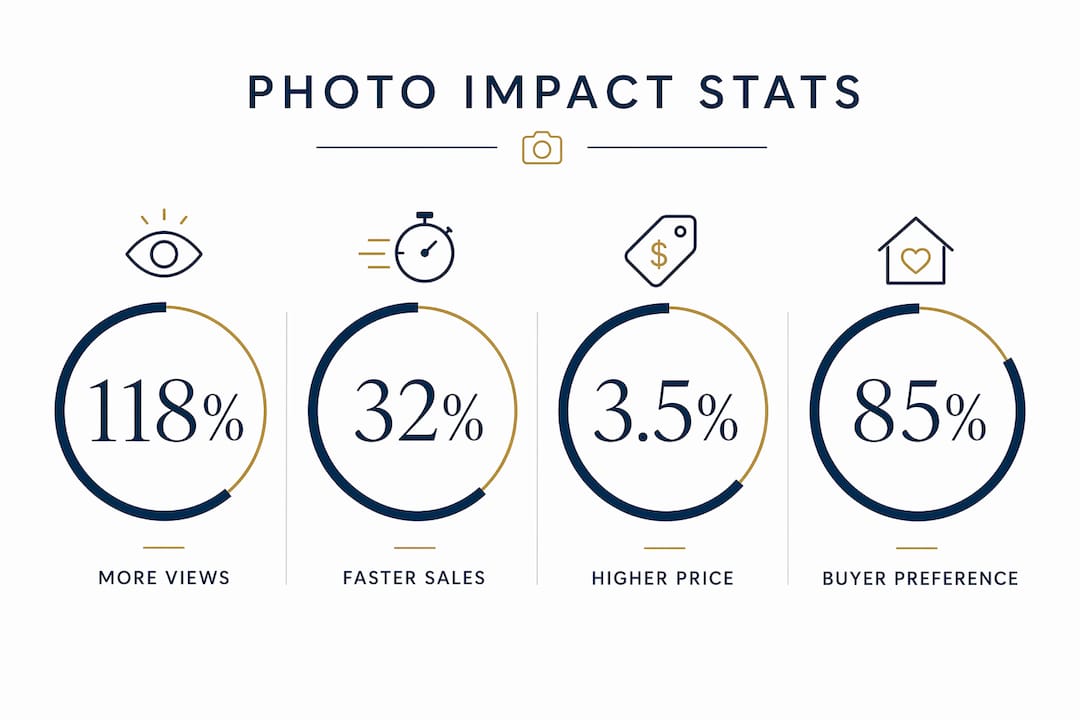
The numbers behind real estate photography benefits are difficult to ignore. Listings with professional photos receive 118% more online views, sell 32% faster, and achieve between 1.2% and 3.5% higher final prices. On a $500,000 home, that price premium alone can represent $6,000 to $17,500 in additional proceeds, which dwarfs the cost of hiring a professional photographer.
Buyer behavior data reinforces this further. Between 81% and 85% of homebuyers rank high-quality photos as the most important factor when evaluating a listing online. That figure outranks price, neighborhood reviews, and written descriptions. Even more telling: 39% of buyers immediately dismiss listings with poor photos without reading any other details. That means nearly four in ten potential buyers are gone before they ever see the price.
“Photos are not just marketing assets. They are the first handshake between a property and a buyer.”
The table below illustrates the performance gap between amateur and professional photography across key listing metrics.
| Metric | Amateur/Smartphone Photos | Professional Photos |
|---|---|---|
| Online views | Baseline | Up to 118% more |
| Days on market | Baseline | 32% faster sale |
| Final sale price | Baseline | 1.2% to 3.5% higher |
| Buyer click-through rate | Lower | Significantly higher |
| Buyer dismissal rate | 39% dismiss poor photos | Minimal dismissal |
These figures confirm that the importance of real estate photos is not a soft marketing preference. It is a measurable commercial outcome.
How do professional photos create emotional appeal beyond technical quality?
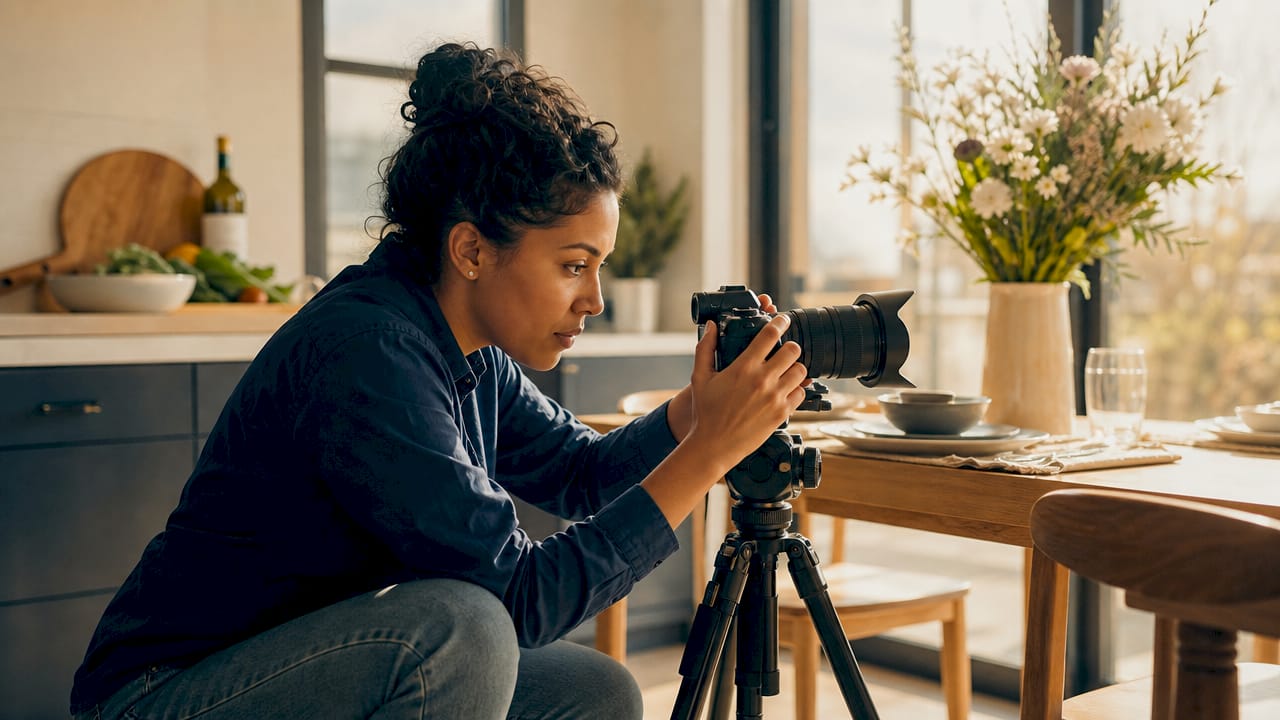
Technical sharpness gets a buyer to look. Emotional resonance gets them to call. Professional photos tell an emotional story that helps buyers imagine living in the space, not just touring it. That distinction matters because most purchasing decisions, including real estate, are emotionally driven first and rationally justified second.
Eye-tracking research shows that buyers evaluate photo brightness first, then perceived space, then decor, in that exact order before deciding to click. This means lighting is not just a technical variable. It is the first emotional signal a photo sends. A dark, flat image communicates neglect. A bright, well-lit room communicates possibility.
Composition and staging amplify this effect. Wide-angle shots that show natural flow between rooms help buyers mentally place their furniture. Warm lighting in a kitchen suggests comfort and family life. A well-staged living room with clean sightlines creates a sense of space that a cluttered, poorly lit version of the same room cannot. These are not accidental outcomes. They are the result of deliberate photographic choices.
Pro Tip: Schedule your photography session after staging is complete and during mid-morning hours when natural light is at its most flattering. This single scheduling decision affects brightness, shadow quality, and the emotional tone of every interior shot.
Key emotional triggers that professional real estate photography activates include:
- Brightness and openness: Signals space and cleanliness, reducing buyer hesitation
- Warm color tones: Evoke comfort and livability in kitchens, living rooms, and bedrooms
- Consistent perspective: Wide-angle shots at consistent heights create a sense of order and professionalism
- Lifestyle staging: Towels in bathrooms, books on shelves, and plants on counters make spaces feel inhabited and desirable
Professional photography vs. smartphone photos: what difference does it really make?
The gap between professional and smartphone photography in real estate is wider than most agents expect. Homes with professional photos sell 32% faster and receive 61% more views compared to listings shot on a phone. The return on investment can exceed 20 times the cost of the session. For a photographer charging $300, that ROI math is straightforward on any listing above $200,000.
The technical reasons for this gap are concrete. Professional photographers use full-frame DSLR or mirrorless cameras, wide-angle lenses calibrated for interior spaces, and off-camera flash systems that balance ambient and artificial light. Smartphone cameras, even flagship models from Apple or Samsung, use computational photography that compresses dynamic range and distorts perspective at close distances. The result is images that look acceptable on a phone screen but flat and cramped on a desktop browser where most serious buyers conduct their search.
| Feature | Smartphone Photos | Professional Photos |
|---|---|---|
| Lens quality | Fixed, wide distortion | Calibrated wide-angle, minimal distortion |
| Lighting control | Auto, often flat | Off-camera flash, balanced exposure |
| Post-processing | Basic filters | Full retouching and color correction |
| Perceived space | Often cramped | Spacious and inviting |
| Buyer engagement | Lower click-through | Significantly higher |
Beyond still photography, professional real estate media acts as a strategic investment that protects commission by reducing stagnant listings and price drops. Adding virtual staging, 3D tours via Matterport, or video walkthroughs to a professional photo package extends the marketing reach further, particularly for out-of-state buyers who cannot visit in person. The visual content for real estate ads that performs best combines a strong hero photo with at least one immersive media format.
What ethical standards should guide real estate photo editing?
Photo editing in real estate exists on a spectrum, and knowing where the line falls protects both agents and buyers. Light retouching, including sky replacement, color correction, and minor blemish removal, is standard practice and widely accepted. Over-editing to hide structural flaws creates buyer distrust and can reduce final sale prices or cause deals to fall through entirely when buyers arrive and find a property that does not match its photos.
The National Association of Realtors and several state-level regulators have addressed this directly. California and Wisconsin, for example, have disclosure requirements that apply when digitally altered images are used in listings. Agents who use AI-generated virtual staging without disclosing it risk violating these rules and damaging their professional reputation.
Pro Tip: Add a simple disclosure line to any listing that uses virtual staging or significant digital enhancement. Something as brief as “Photos may include virtual staging” satisfies most regulatory requirements and builds buyer trust rather than eroding it.
Follow these numbered guidelines to keep your editing practices ethical and legally sound:
- Correct exposure, color balance, and lens distortion freely. These are technical corrections, not misrepresentations.
- Use virtual staging only on vacant rooms and always disclose it in the listing description.
- Never remove or digitally alter structural elements such as cracks, water stains, or damaged flooring.
- Match the edited photo’s brightness and color to what a buyer will actually see during a showing.
- Review state-specific disclosure requirements before publishing any digitally enhanced images.
Balancing enhanced appeal with truthful representation is not just an ethical obligation. It is a practical one. Buyers who feel misled by photos withdraw offers, leave negative reviews, and rarely refer business.
How to integrate photography into a complete listing marketing strategy
The impact of images in property marketing multiplies when photos are deployed strategically across every channel, not just uploaded to the MLS and forgotten. The hero photo deserves particular attention. Daytime exterior shots achieve an 8.5% click-through rate compared to 6.6% for twilight shots and lower rates for drone-only leads. Buyers respond to clarity and familiarity. A clean, well-lit front exterior tells them exactly what they are looking at.
Once you have the right hero photo, the distribution strategy determines how far that image travels. A strong set of listing photos should appear across the MLS, Zillow, Realtor.com, the agent’s website, Instagram, Facebook ads, and any print materials. Each platform has different image dimensions and compression settings, so exporting photos at the correct resolution for each channel preserves quality and prevents the blurry, pixelated look that undermines credibility.
Agents who build a visible portfolio of consistently high-quality listing photos generate leads beyond the current listing. Sellers researching agents compare marketing quality before they ever make a call. A gallery of sharp, well-lit, professionally presented listings signals competence more convincingly than any bio paragraph. This is how photography becomes a long-term brand asset, not just a per-listing expense.
For real estate teams managing multiple listings, consider these distribution priorities:
- MLS and major portals: Upload the maximum allowed photo count with the hero exterior first
- Social media: Use square crops for Instagram and horizontal crops for Facebook ads; test multiple hero images to find the highest-performing version
- Email campaigns: Feature the hero photo above the fold with a direct link to the full listing
- Print materials: Use only high-resolution exports (300 DPI minimum) for flyers and postcards
- Agent website: Create individual property pages with full photo galleries to improve SEO and keep buyers on your site longer
You can explore how professional photos convert across these channels in more detail, including specific examples of how image quality affects ad performance and lead quality.
Key takeaways
Professional real estate photography directly increases listing views, accelerates sales, and raises final offer prices, making it one of the highest-return investments available to any agent or marketer.
| Point | Details |
|---|---|
| Photos drive buyer decisions | Between 81% and 85% of buyers rank photo quality as the top listing evaluation factor. |
| Professional photos outperform smartphones | Professional images generate 61% more views and sell homes 32% faster than phone photos. |
| Emotional storytelling matters | Lighting, staging, and composition trigger buyer psychology beyond simple documentation. |
| Ethical editing protects deals | Over-editing misleads buyers, risks legal violations, and can collapse transactions at inspection. |
| Hero photo selection is data-driven | Daytime exterior shots achieve the highest click-through rates; test before committing to one. |
Why I think most agents are still undervaluing their listing photos
Here is what I have observed working with real estate professionals across South Florida: most agents understand that photos matter, but very few treat them as the primary marketing asset they actually are. They budget carefully for staging, signage, and open house refreshments, then hand the photography to whoever is cheapest or most convenient. The result is a listing that looks fine but does not stop anyone mid-scroll.
The data tells a different story than the behavior. When professional photography is a commercial lever that works at every price point, not just luxury listings, there is no logical argument for cutting corners on a $300,000 starter home. The percentage return is identical. The buyer psychology is identical.
What I find even more underappreciated is the long-term brand argument. Every listing you photograph professionally becomes a permanent piece of your marketing portfolio. Sellers searching for an agent in your market will see those images before they ever speak to you. That gallery is doing sales work around the clock without any additional effort from you. Agents who understand this stop thinking about photography as a per-listing cost and start treating it as infrastructure.
The ethical dimension also deserves more honest conversation. I have seen deals fall apart at the inspection stage because the photos set expectations the property could not meet. That outcome costs everyone time, money, and trust. Accurate, flattering photography is not a compromise. It is the professional standard.
— Mike
How Eric Campbell Photography supports real estate professionals
Real estate professionals across South Florida trust Eric Campbell Photography for photography that performs. Whether you need polished real estate headshots that build your personal brand or a complete branding session that gives you consistent imagery for your website, social media, and listing materials, the studio delivers fast turnaround and guided sessions that take the guesswork out of the process. For agents in Boca Raton and the surrounding area, professional photography services are available with same-day gallery delivery and editing matched to your brand’s style. Visit ericcampbellphotography.com or call 954.766.1954 to plan your session.
FAQ
How much do professional real estate photos increase views?
Listings with professional photography receive up to 118% more online views than those without. That increase translates directly into more showing requests and faster offers.
Do professional photos actually increase the sale price?
Yes. Professional listing photos are associated with final sale prices between 1.2% and 3.5% higher than comparable listings using amateur photography. On a $400,000 home, that range represents $4,800 to $14,000 in additional proceeds.
What is the best hero photo for a real estate listing?
Daytime exterior shots consistently outperform other options, achieving an 8.5% click-through rate in controlled buyer experiments. Twilight and drone shots perform lower and should be used as supporting images rather than the lead photo.
Is virtual staging ethical in real estate listings?
Virtual staging is ethical when disclosed. Agents should include a brief note in the listing description indicating that photos may include virtual staging. Undisclosed digital alterations can violate state regulations in markets like California and Wisconsin.
Does professional photography benefit lower-priced listings?
Professional photography is a commercial lever that benefits all price points, not just luxury properties. The percentage return on views, days on market, and final price holds consistent regardless of listing price.