

TL;DR:
- Your headshot influences perceptions of your professionalism and credibility before you speak.
- A career-stage headshot is styled to reflect your current role and future goals, not just appearance.
- Updating your headshot every two to three years ensures your professional image remains current and authentic.
Your headshot is working for you right now, whether you realize it or not. Every recruiter who lands on your LinkedIn profile, every client who Googles your name, every conference organizer reviewing your speaker bio — they are all forming an opinion before you say a word. Understanding what is a career-stage headshot, and why it differs from a generic professional photo, is one of the most underrated moves you can make for your career at any level.
Table of Contents
- Key takeaways
- What is a career-stage headshot, exactly?
- Why your career-stage headshot matters more than you think
- How to take a career-stage headshot that actually works
- How career-stage headshots differ by profession
- My honest take on why most professionals get this wrong
- Get a headshot that matches where you are headed
- FAQ
Key takeaways
| Point | Details |
|---|---|
| Career stage shapes headshot style | Entry-level, mid-career, and executive professionals need different visual cues to match their goals and audience expectations. |
| First impressions happen fast | People judge trustworthiness within milliseconds, making the quality and tone of your headshot critical. |
| Wardrobe and expression are strategic | Color, framing, and expression should reflect your industry and career level, not just personal preference. |
| Update every two to three years | Your headshot should evolve as your role and career stage change to stay current and credible. |
| A good headshot is a long-term asset | A professional photo works across platforms for two to three years, making it a cost-effective investment. |
What is a career-stage headshot, exactly?
A career-stage headshot is a professionally photographed portrait that is intentionally styled, framed, and presented to reflect where you are in your career right now and where you are trying to go next. It is not just a photo of your face in professional clothing. It is a visual signal that communicates your level of experience, your professional identity, and the kind of opportunities you want to attract.
This is the part most people miss. A generic headshot treats all professionals the same. A career-stage headshot treats you as the specific professional you are, at this specific point in your career. The career headshot definition goes beyond “looks professional” to ask: professional for whom, and for what purpose?
Here is how the differences typically break down across career stages:
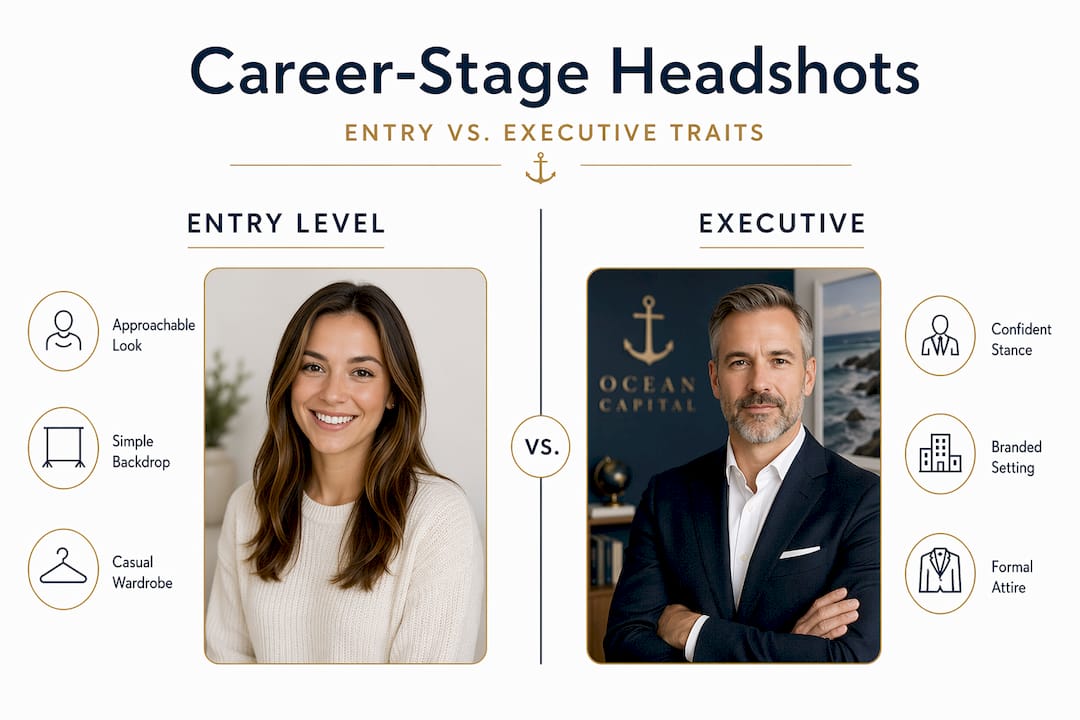
- Entry-level professionals benefit from headshots that feel approachable and energetic. Clean backgrounds, open expressions, and wardrobe that signals readiness without trying to look like a CEO. The goal is to communicate potential and personality.
- Mid-career professionals need headshots that project confidence and competence. The expression tends to be more settled, the wardrobe more polished, and the framing slightly tighter to convey authority without distance.
- Senior executives and leaders often use headshots that communicate gravitas and trustworthiness. The styling leans toward classic, the expression is composed, and every element reinforces the idea that this person is in command.
- Career changers and re-entrants need headshots that bridge their past experience with their new direction. The visual tone should align with the industry they are moving into, not the one they are leaving.
The career-stage approach also accounts for industry. A creative director at an ad agency and a partner at a law firm are both senior professionals, but their headshots should look nothing alike. One signals creative authority; the other signals precision and trust.
Why your career-stage headshot matters more than you think
The importance of career headshots is backed by real data, not just conventional wisdom. LinkedIn profiles with professional photos receive 21 times more views and 9 times more connection requests than profiles without them. That gap is not about vanity. It is about visibility and perceived credibility.
The psychology behind this is straightforward. People form judgments about competence and trustworthiness within 100 milliseconds of seeing a face. Your headshot is often the first face they see. A photo that looks rushed, outdated, or misaligned with your career level does not just fail to impress. It actively works against you.
“Consistent professional imagery reassures clients that you maintain similar standards in your work as you do in your visual presentation.” — KBEW research on professional headshots
This is especially true for professionals who rely on digital platforms to generate business or attract opportunities. A career advancement headshot signals that you take your professional presence seriously. It tells the viewer, before a single word is read, that you are credible and prepared.
The flip side is equally important. Amateur photos like selfies or cropped group shots can undermine your professional credibility before a potential client or employer ever meets you. The cost of a weak headshot is not just missed clicks. It is missed opportunities.

How to take a career-stage headshot that actually works
Knowing what makes a good headshot starts before you ever step in front of a camera. The preparation is where most of the work happens.
- Define your goal first. Are you looking for a promotion, launching a business, or transitioning into a new industry? Your headshot should reflect the professional you are becoming, not just the one you are today. Share this context with your photographer before the session.
- Choose wardrobe strategically. Mid-tone colors like navy, emerald green, burgundy, and charcoal photograph well and read as professional across industries. Avoid bright colors like neon pink or turquoise, and skip busy patterns that distract from your face. The goal is for the viewer to remember you, not your shirt.
- Match your expression to your career level. Entry-level professionals often benefit from a warm, open smile. Senior professionals may project more authority with a composed, confident expression. Neither is wrong. Both are intentional.
- Think about background. A clean background headshot works well for most corporate and medical professionals. Creative professionals may benefit from a more textured or environmental background that hints at their work context.
- Brief your photographer on the platforms you use. A headshot for a LinkedIn profile crops differently than one for a speaker bio or a hospital website. Knowing the end use helps the photographer frame and compose the shot correctly.
- Update your headshot every two to three years, or sooner if your role, industry, or appearance changes significantly. Updating your headshot as your career evolves keeps your professional brand current and authentic.
Pro Tip: Bring two or three wardrobe options to your session. Different looks give you flexibility for different platforms. Your LinkedIn photo and your company website photo do not have to be identical.
The national median cost for a professional headshot session is around $250 for two to three edited images. That investment works across your digital presence for two to three years, making it one of the most cost-effective tools in your personal branding toolkit.
How career-stage headshots differ by profession
One of the clearest ways to understand the career-stage headshot concept is to see it mapped across different professions and levels. The same principles apply everywhere, but the execution looks very different depending on your field.
| Career Stage | Corporate Professional | Creative Professional | Medical Professional |
|---|---|---|---|
| Entry-level | Clean backdrop, business casual, warm smile | Relaxed setting, expressive, personality-forward | White coat optional, approachable expression |
| Mid-career | Polished attire, neutral background, confident expression | Branded environment, deliberate styling, creative energy | Clinical setting or clean studio, composed and credible |
| Senior/Executive | Classic wardrobe, authoritative framing, composed expression | Editorial quality, distinctive personal brand visible | Formal attire, institutional gravitas, trust-forward |
| Career changer | Reflects new industry’s visual norms, forward-looking tone | Portfolio-aligned, bridges past and new direction | Matches specialty or program expectations |
The subtle cues matter enormously. A senior attorney and a senior creative director are both accomplished professionals, but their headshots send different signals. The attorney’s photo communicates precision and reliability. The creative director’s communicates vision and originality. Both are correct for their context.
Pro Tip: Research the LinkedIn profiles of people in the role you want, not just the role you have. Notice the visual tone of their headshots. That is your benchmark.
For medical professionals, the stakes are particularly specific. Residency applications, hospital websites, and program directories all have visual expectations that differ from a general corporate headshot. A professional image for medical settings often requires a balance of clinical authority and patient-facing warmth. Getting that balance right in a single photo takes intentional direction, not just good lighting.
My honest take on why most professionals get this wrong
I have worked with hundreds of professionals across every career stage, and the pattern I see most often is this: people treat their headshot as a box to check rather than a decision to make. They grab whatever photo looks decent, upload it to LinkedIn, and move on. Years pass. The photo stays.
What I have learned is that the professionals who update their headshots intentionally, and who think carefully about what their image communicates at each stage, consistently present themselves more confidently across every platform. It is not about looking younger or more polished. It is about looking current and aligned with where you are going.
The contrarian view I would offer is this: the headshot conversation is not really about photography. It is about personal branding strategy. The photo is just the output. The thinking that goes into it, the career goals, the industry context, the visual signals you want to send, is the real work. Most people skip that thinking entirely. The ones who do not tend to get more out of every platform their photo appears on.
If you are at a career inflection point, whether that is a promotion, a pivot, or a new business, your headshot should reflect that transition. A photo from three years ago in a role you have outgrown is not just outdated. It is telling the wrong story.
— Mike
Get a headshot that matches where you are headed
At Eric Campbell Photography, every session starts with a conversation about your goals, not just your outfit. Whether you are an entry-level professional building your first LinkedIn presence, a mid-career leader refreshing your brand, or an executive who needs imagery that reflects your current standing, the approach is tailored to your specific career stage.
The studio serves professionals across Fort Lauderdale, Broward, Palm Beach, and Miami-Dade counties, with professional headshot sessions designed for real people who do not necessarily love being in front of a camera. You get clear direction, wardrobe guidance, and fast turnaround. Many clients receive their gallery the same day. If you are ready to invest in a photo that actually works as hard as you do, plan your session at ericcampbellphotography.com or call 954.766.1954.
FAQ
What is a career-stage headshot?
A career-stage headshot is a professional portrait styled and framed to reflect your current career level and goals, whether you are entry-level, mid-career, or executive. It differs from a generic headshot by aligning your visual presentation with the specific opportunities you want to attract.
How often should I update my professional headshot?
You should update your headshot every two to three years, or sooner when your role, industry, or appearance changes significantly. Keeping your photo current maintains an authentic and credible professional brand.
What makes a good headshot for a job search?
A good professional headshot for a job search uses a clean background, appropriate wardrobe for your industry, and an expression that balances confidence with approachability. LinkedIn profiles with quality photos receive significantly more views and connection requests than those without.
Does wardrobe really affect how my headshot performs?
Yes. Mid-tone colors like navy, charcoal, and burgundy photograph well and read as professional across industries. Bright colors and busy patterns draw attention away from your face, which is where the viewer’s focus should stay.
Can one headshot work for every platform?
Not always. A headshot for LinkedIn crops differently than one for a speaker bio or a hospital directory. Bringing multiple wardrobe options to your session and briefing your photographer on your intended platforms gives you more flexibility and better results across all of them.